Thai Massage: What to Expect From Your First Session
Your first Thai massage: why discomfort comes before relief
A competent Thai massage is meant to feel uncomfortable at points before it feels good, and that’s not a warning sign, it’s the treatment working. Unlike a Western relaxation massage, which is built to avoid discomfort entirely, traditional Thai massage moves your joints and muscles through ranges you don’t normally reach on your own. That’s what people mean when they talk about deep stretching, and it’s exactly why first-timers so often come away confused about whether they enjoyed it.
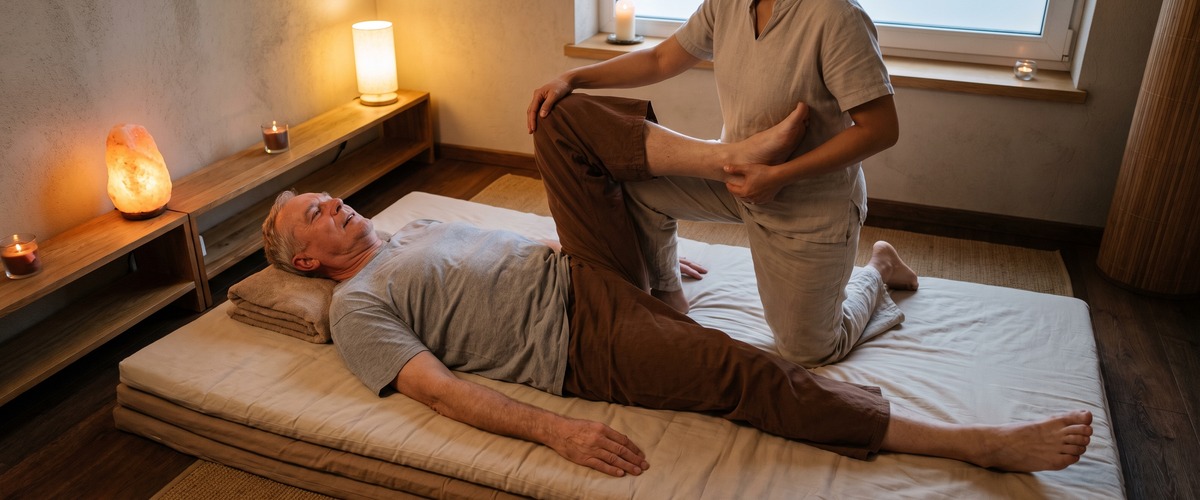
You stay fully clothed for the traditional mat treatment. That surprises a lot of first-time clients, who assume every massage means undressing. At Glasgow Thai Massage, traditional Thai massage happens on a floor mat in loose, comfortable clothing we provide.
It uses acupressure and assisted stretching rather than oils. If you’d prefer an oil treatment, Thai Oil Massage is a separate booking. Try not to mix the two up when you choose.
You can book your first session online once you know which type suits you. The rest of this article covers the part nobody quite prepares you for. That’s the middle of the session, where it stops feeling relaxing and starts feeling like real work.
What assisted stretching actually feels like
Assisted stretching is just what it sounds like. The therapist uses their own bodyweight, hands, and sometimes feet to move your limbs. They take you into a stretch you couldn’t reach on your own.
It sits at the heart of traditional Thai massage, alongside acupressure along the body’s sen energy lines. In Thai tradition, those lines are the pathways where tension and stiff movement travel. The therapist holds and controls the stretch, not you.
That’s precisely why it can catch first-timers off guard.
Maliwan trained at Wat Pho in Bangkok and has practised for over twenty years. She remembers a client who nearly cancelled his first session. He’d heard stories about being folded into odd shapes.
Once he understood that he stayed fully clothed and set the pressure himself, he relaxed completely. Now he books monthly, because it’s the one hour he actually switches his phone off. That fear of being twisted somewhere unfamiliar is worth naming honestly rather than glossing over.
Professional boundaries matter here as much as technique does. A legitimate therapist works the legs, hips, back, shoulders, and feet. They check in about pressure often, and they never stray outside clearly defined territory.
Glasgow’s city centre has seen its share of scrutiny over places that blur that line. So it pays to choose a registered studio with a fixed address, like our Victoria Chambers premises on West Nile Street.
Why the ache before ease is the point, not a warning sign
The usual industry line is that Thai massage is a gentler option than deep tissue work. That misses what’s actually going on. Deep tissue massage releases tension with direct, steady pressure into the muscle, usually with oil.
Thai massage reaches the same tension by a different route: assisted stretching and acupressure along the sen lines. It can feel just as intense. The intensity simply arrives as a stretch instead of a dig.
Jariya has noticed something about clients who arrive wound tight. They often hold their breath during the first few stretches without realising it. She points out when their breathing has settled back to normal partway through.
Most people are surprised at how much tension they were carrying in their breathing alone. That shift, from held breath to easy breath, usually comes right after the part that felt most uncomfortable.
In our experience, the clients who benefit most are the ones who feel the least at ease early on. Maliwan worked with a woman who had spent fifteen years at a desk and could barely turn her head more than a few degrees. The first session was not comfortable for her. By the end of it she could move her neck freely again, and she got a little tearful, because she’d forgotten what that even felt like.
Another client, a financial analyst in her early forties working near St Vincent Street, came to us with five years of lower back pain. She’d already tried daily stretching and a standing desk. It took six weekly Traditional Thai Massage sessions before the pain genuinely settled, and the early sessions were the hardest ones.
That’s the honest timeline, and it’s the bit most first-timer guides leave out. One session shows you what’s tight. A short run of them is what changes it.
If you’ve read forums before booking, you’ve probably seen someone ask about being “twisted like a pretzel.” The honest answer is simple. A good therapist takes you close to your edge, not past it. The discomfort is your real range being challenged, not exceeded.
UNESCO recognised Nuad Thai as Intangible Cultural Heritage in 2019. The practice is built on rebalancing the body through guided, structured movement rather than passive relaxation.
What to expect from your first Thai massage session, step by step
Most first sessions run 60 to 90 minutes. That’s enough time to work the major sen lines without rushing the stretches. You’ll change into loose clothing and lie on a padded mat rather than a table.
The therapist starts with lighter pressure across the back and legs, then builds toward the deeper stretches. Reviews of our studio often mention how nervous first-timers arrive, and how quickly a calm, respectful room puts them at ease. That matches what we see every week.
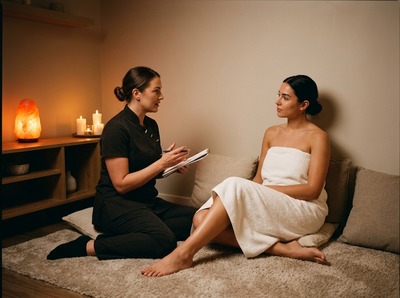
Communication matters more here than in most other treatments. Pressure and stretch depth vary a lot from client to client. Tell your therapist if something crosses from useful discomfort into real pain.
They’ll adjust straight away. Cleveland Clinic notes that Thai massage can ease muscle tension and improve flexibility over a course of sessions. Responses differ from person to person, so mention any injuries or conditions before you start.
Expect your therapist to be interested in more than the sore spot itself. Jariya once worked with a runner who’d been through several sports massage therapists and kept picking up the same injury. Mapping out how her left hip was pulling her whole posture forward explained the pattern, and that’s the kind of thing an hour of assisted stretching tends to reveal.
You can reserve a session here. Say it’s your first time when you book, so the therapist can pace the pressure to suit you. Maybe sciatica, long-term lower back pain, or sports recovery is what’s pushing you to try Thai massage.
If so, read our page on Thai sports massage alongside this one. The two treatments overlap more than people expect.
A first Thai massage that never feels uncomfortable probably isn’t doing much. The discomfort is the stretch reaching muscle and joint ranges you don’t use day to day. The ease that follows is your body responding to that work.
It isn’t a reward for surviving it. Book with that expectation, and the whole session makes far more sense from the first stretch onward.
Sources:
- Nuad Thai, traditional Thai massage — UNESCO Intangible Cultural Heritage
- Thai Massage: What It Is and 5 Benefits — Cleveland Clinic
Found this useful? Add blog.glasgowthaimassage.co.uk as a preferred source on Google so our latest guides show up first for you in Search and AI Overviews.