Thai massage benefits that go far beyond relaxation

Thai massage benefits that outlast the massage itself
Most people expect a Thai massage to mean relaxation. Ask them a week later what actually changed, though, and the answer’s usually more specific: their headaches eased off, or at least stopped turning up every Thursday afternoon. That’s the real story with Thai massage benefits.
You’ll often hear that Thai massage improves flexibility and eases stress. Both are true enough. What rarely gets mentioned is what the compression and stretch sequence actually does during a traditional session.
It often eases tension headaches that clients had long stopped connecting to their shoulders and neck at all.
We see this pattern often enough at Glasgow Thai Massage that it doesn’t surprise us anymore. Someone books in for backache or general tightness, and partway through the session, almost as an aside, they’ll mention their afternoon headaches have quietly gone.
They didn’t come in for that. They never even mentioned headaches as a problem. The shoulder and neck work just got there first.
Why the compression and stretch sequence matters more than the relaxation
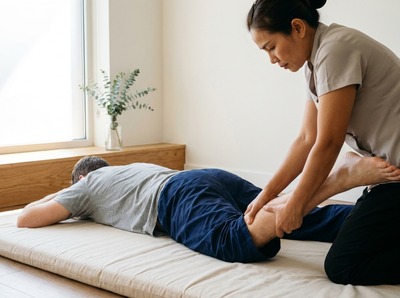
Traditional Thai massage works quite differently from a Swedish or oil massage. There’s no long gliding stroke here. Instead, a practitioner applies rhythmic palm and thumb compression along the body’s sen energy lines.
That’s paired with assisted stretching, taking your joints through ranges you’d never reach on your own. The relaxation you feel isn’t a side effect of that work — it’s the result of it.
Maliwan founded Glasgow Thai Massage after training at Wat Pho in Bangkok, and she still remembers one client whose shoulders were so locked after fifteen years at a desk that she could barely turn her head a few degrees either way. After one session, she could move her neck freely again.
She was visibly moved — she’d simply forgotten what that kind of movement felt like.
That’s not a relaxation story. It’s a mechanical one — and it’s behind a lot of the headache relief clients describe without ever asking for it.
If any of that sounds familiar, come in and let us look at where the tension actually starts.
How Thai massage benefits the neck and shoulders specifically
Most tension headaches don’t actually start in the head. They build in the trapezius and levator scapulae muscles, across the shoulders and the base of the skull, tightening slowly enough that you adjust to it rather than notice it happening.
A systematic review of court-type Thai traditional massage found measurable changes in blood flow and skin temperature around the neck, shoulder, and arm after treatment. That matches what clients tell us: warmth, looseness, and a headache that simply doesn’t turn up that evening.
This is where deep tissue massage and traditional Thai massage really part ways, and it’s worth knowing before you book. Deep tissue massage works straight into the muscle layers with steady pressure, usually with oil.
It’s excellent for one stubborn knot or a tight spot. Traditional Thai massage, done fully clothed on a mat, works differently — along broader lines, mixing pressure with movement to treat the whole pattern rather than a single point.
For headaches rooted in shoulder and neck tension, it’s usually that wider pattern that needs the attention.
We saw this clearly with one client, a financial analyst in her early forties who had lived with lower back pain for five years. She’d tried regular stretching and a standing desk, and neither had shifted it.
After six weekly Traditional Thai Massage sessions, the pain had eased to something she barely thought about. What she hadn’t expected was the second change: the low-grade headaches she’d blamed on screen time eased off too. In our experience, that pairing is the rule rather than the exception.
Glasgow Thai Massage clients booking through our main services page often ask which treatment suits them best. If headache relief is the goal, Traditional Thai Massage is usually the better starting point over an oil treatment. So is Thai Sports Massage, if your tension comes from training rather than a desk.
Who should be cautious with Thai massage
It’s a fair question, and it deserves a straight answer rather than a vague disclaimer. Thai massage isn’t recommended during the first trimester of pregnancy, and it’s not suitable for anyone with a fresh injury a doctor hasn’t yet seen.
The same applies to certain circulatory conditions, where deep compression could cause harm. If you have a diagnosis, check with your GP first — and letting your therapist know before the session begins matters just as much.
This is standard guidance from the NHS and most reputable massage bodies. It isn’t a Glasgow Thai Massage rule.
What clients notice that reviews keep repeating
Have a look through reviews for massage studios in Glasgow and one theme keeps coming up. People describe pain relief in their own words rather than reaching for generic praise. They talk about feeling lighter afterwards, or the soreness simply disappearing.
It’s rarely put as ‘I relaxed.’ It’s put as a specific, physical change. That tells you what people are really coming back for, the second and third time.
It isn’t the hour away from their desk. It’s that something which had nagged at them for months has quietly stopped.
Jariya works alongside Maliwan and has noticed a related pattern in stressed clients. Many arrive holding their breath without even realising it. By the midpoint of the session, once the shoulders begin to let go, their breathing settles again.
That one shift changes how the rest of the treatment lands. It’s a small detail, but it explains why the benefits carry on well after the session has ended.
If you work near Blythswood Square or the financial district on St Vincent Street, the walk to our studio on West Nile Street fits easily into a lunch break. The effect on afternoon tension headaches is often worth far more than the walk. You can book a session online if you’d rather test that than take our word for it.
Getting the most from a single session
A few small habits make a real difference to how much benefit you take from the session. Drink water before and after, since the compression work moves fluid through tissue that’s been still for a long while. Try not to book straight before anything demanding.
As the shoulders and neck loosen up, you might feel a touch less sharp for an hour or two.
Don’t judge the session only by how you feel walking out the door. In our experience, much of the change in headache frequency and muscle tension builds over the following day or two. It rarely arrives all at once.
For recurring tension headaches, weekly sessions for the first few weeks give the clearest results. After that, monthly is usually enough. You can book your appointment here to start that pattern.
Or read our deep tissue massage guide if you’re weighing it up against traditional Thai technique.
None of this means relaxation doesn’t matter — it clearly does, and it’s still the first thing most people feel on the mat. But if you’ve lived with a dull, recurring headache and assumed it had nothing to do with the knot behind your shoulder blade, that’s an assumption worth questioning.
Book a Thai massage session with the mechanism in mind, not just the mood you hope to leave in. The benefit you didn’t book for may be the one that sticks.
Sources:
- The effects of the court-type Thai traditional massage on anatomical relations, blood flow, and skin temperature of the neck, shoulder, and arm (NCBI)
- The immediate effects of traditional Thai massage on heart rate variability and stress-related parameters (PubMed)
- Thai massage: 5 benefits and side effects (Medical News Today)
- Thai Massage: What It Is and 5 Benefits (Cleveland Clinic)
Found this useful? Add blog.glasgowthaimassage.co.uk as a preferred source on Google so our latest guides show up first for you in Search and AI Overviews.